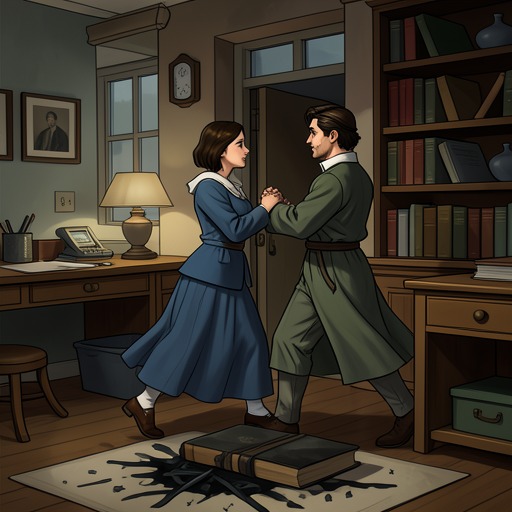
Amy March–Laurie relationship
Little WomenThe Amy March–Laurie relationship is one of the novel’s most important reversals: it begins in the shadow of Laurie’s intimacy with Jo and Amy’s youthful ambition to escape poverty through a wealthy marriage, then develops into a partnership in which affection proves more necessary than status. Their eventual marriage does not erase the earlier disappointments. Instead, it converts them into a new emotional understanding, allowing Amy to become a lovable woman on her own terms and Laurie to find happiness after accepting that Jo could not return his love.
Childhood Proximity and the Laurence Connection
Amy and Laurie belong to neighboring but sharply contrasting worlds. The March family home is an old, brown, somewhat bare house, while the Laurence mansion across the low hedge announces comfort and luxury through its stone walls, coach house, conservatory, and carefully kept grounds. Jo first crosses this social and spatial boundary by imagining the lonely mansion as an enchanted palace and seeking out the isolated boy at its upper window. Laurie leads Jo through the house to a library filled with books, pictures, statues, cabinets of coins and curiosities, bronze objects, unusual tables, and a great open fireplace. This setting establishes the Laurence household as both materially privileged and emotionally incomplete, while the March sisters supply the society and warmth Laurie lacks.
Amy therefore knows Laurie first through the family friendship created around Jo, Beth, and the neighboring household. Their bond is not initially presented as a courtship. Laurie is treated as the sisters’ boyish companion, and the relationship remains enclosed within a wider network of domestic affection. Jo’s hedge post office, established in the old martin house with a key for each household, makes the boundary between the two families porous: letters, manuscripts, books, and bundles can pass between adjoining nations. That imaginative institution anticipates the later movement of feeling across family and social boundaries, even though Amy’s eventual intimacy with Laurie emerges only after both have changed.
Amy’s European Reassessment of Marriage
In Europe, Amy initially evaluates Fred Vaughn according to a logic of security, comfort, and social advancement. She admits that she has come to hate poverty and has decided that one of the sisters must marry well. Fred is handsome, young, sufficiently clever, very rich, and connected with a family whose city house, jewels, servants, country estate, park, horses, and solid luxury represent the life Amy desires. She does not claim to love him passionately, but believes that affection might grow if he loved her and allowed her freedom. Her reasoning is neither a plan to marry a man she despises nor a purely romantic dream; it is a deliberate attempt to make marriage answer the material insecurity that has shaped the March family.
Laurie’s arrival at Nice begins to unsettle that calculation. On Christmas Day he recognizes Amy in a small carriage, sees the young blonde woman in blue, and hurries forward waving his hat. Amy has already begun to see him differently. Time and absence have changed Laurie from “our boy” into a handsome and agreeable man, and she deliberately dresses to please him, using inexpensive tarlatan, tulle, flowers, and a few trinkets to create an attractive appearance. Her preparation is artistic as well as romantic: she knows how to shape an impression, but her desire is no longer merely to display herself to society. She wants Laurie to think she looks well and to carry that favorable impression home.
The decisive change occurs when Fred returns and proposes. Amy, who had once resolved to answer yes, now answers no, kindly but firmly. Money and position no longer satisfy the deeper longing that has taken possession of her. She begins to regret her earlier declaration that she would marry for money and worries that Laurie may regard her as heartless and worldly. Her ambition to become a queen of society weakens beside her desire to become a lovable woman. This is not a sudden rejection of practical judgment; it is a reordering of values in which emotional truth becomes more important than the social advantages Fred represents.
Recognition Through Grief and Distance
Laurie’s own emotional history remains central to the relationship. He has been altered by Jo’s refusal, and Amy gradually reads that change through his silences, his unwillingness to speak voluntarily of Jo, the shadow on his face, and the old ring he continues to wear. When she recognizes that a love trouble lies beneath his altered character, her concern becomes tender rather than competitive. She knows that she has no right to lecture him, yet cannot bear to see the family disappointed in him. Laurie answers in a grim tone that suggests how deeply Jo’s rejection has wounded him.
Amy’s letters then become an important form of attachment and care. She writes twice a week, asks Laurie’s opinions, follows his activities, gives him small presents, and fills her letters with lively gossip, confidences, and sketches of the places she visits. She treats him like a brother because Jo refuses to love him, but the supposed brotherly intimacy increasingly carries the emotional weight of courtship. Amy grows paler and more pensive, loses some of her taste for society, and goes out sketching alone. Her correspondence is not only a pleasure but, as she understands it, a duty toward a lonely man who needs kindness. The relationship thus develops through sustained attention rather than through a single declaration: care becomes the language in which unspoken love is gradually recognized.
The turning point comes at La Tour near Vevay. Laurie finds Amy in an old garden beside the lake, sitting with a homesick heart and heavy eyes, surrounded by blotted letters, sketches, a black ribbon, and the little ebony cross he had given her. He sees in her face the tender side of her character, including a capacity for sorrow and patience that he had not previously understood. When Amy looks up and runs to him, crying, “Oh, Laurie, Laurie, I knew you'd come to me!”, the greeting reveals a love that neither has successfully concealed. They stand together in silence, and each understands the truth: Amy feels that no one could comfort and sustain her so well, while Laurie decides that Amy is the woman who can make him happy after Jo.
From Emotional Resolution to Marriage
Laurie approaches his second courtship differently from his first. His earlier wooing of Jo had been tempestuous and painful; his feeling for Amy develops with greater calm because both already understand what has changed. He does not need to make a theatrical confession, and Amy has effectively given her answer before the formal proposal. Their romance therefore reverses the expected scene of courtship. Laurie imagines a moonlit declaration in the chateau garden, but the relationship is settled at midday on the lake, amid the landscape of St. Gingolph, Montreux, Vevay, Lausanne, and the surrounding Alps. The bluntness of the occasion emphasizes that the decisive work has already occurred internally.
Their marriage also has a practical immediate cause. Laurie wishes to return home with Amy and the Carrols, but the family decides to spend another winter in Paris. James Laurence wants to come home, Laurie cannot leave him alone, and Mrs. Carrol will not permit Amy to travel without a chaperon. Laurie resolves the difficulty by proposing that he and Amy marry, after which they can travel as they please. Marriage is therefore both an emotional fulfillment and a socially legible arrangement, but the evidence makes clear that logistics alone do not create it. The practical solution succeeds because Amy and Laurie have already recognized one another as companions capable of sustaining each other.
When Laurie later explains the marriage to Jo, he describes Amy and himself as one and says that the family had planned to return with the Carrols before their plans changed. His account places the union within the continuing friendship of the Marches and the Lawrences rather than presenting it as a secret departure from them. He acknowledges that Jo and her family have done more for him than he can repay, while laying one hand on James Laurence and the other on Amy. The gesture physically joins his marriage to the grandfatherly bond and family affection that have shaped his life.
Meaning and Later Consequences
The relationship’s significance lies partly in Amy’s moral and emotional development. Earlier, she is publicly punished by Professor Davis for breaking the school’s rule against bringing pickled limes, and she bears the blows with pride because the disgrace matters to her as much as the pain. Her mother refuses to offer simple sympathy: Amy broke the rule and deserved punishment for disobedience, although corporal punishment was not approved. Later Amy identifies selfishness as the largest item in her “bundle of naughties” and resolves to become more like Beth, whose unselfishness makes everyone love and fear losing her. She asks to wear a ring as a reminder of that resolution. Mr. March observes that she serves others patiently, gives up her place, stops looking in the glass, and does not even mention the pretty ring; he is prouder of a lovable daughter who makes life beautiful than of a graceful statue.
These scenes matter to Amy’s relationship with Laurie because they show that her movement toward love is part of a larger shift from self-display and external reward toward inward character and reciprocal care. Her artistic talent and social ambition do not disappear. Rather, they cease to be substitutes for emotional belonging. Laurie’s changed perception depends on seeing not merely the polished young woman who can manage a fashionable appearance, but the grieving, patient, affectionate Amy revealed at La Tour. Their marriage consequently rests on a form of recognition that includes both her cultivated talents and her moral transformation.
The relationship also gains depth from the family’s experience of illness and loss. Beth’s recovery from the scarlet fever crisis is followed by the knowledge that her life is ebbing away. She accepts death through a faith expressed in patience and acts rather than speeches, while Jo struggles rebelliously against losing her. Amy’s wish to become more like Beth shows how deeply Beth’s example shapes her, and Laurie’s eventual union with Amy occurs within the same family history of devotion, grief, and endurance. It is not a replacement that cancels Beth or Jo; it is a new bond formed by people who have learned what love can demand and what loss can change.
After their marriage, Laurie and Amy return to the family circle, and Laurie credits James Laurence and Amy with helping him become someone who will not disappoint those who love him. The larger domestic future confirms that their union is durable rather than merely triumphant. In the astonishing year that follows, Jo becomes married and settled at Plumfield, while Laurie and Amy remain part of the extended network of family counsel, hopes, and plans. Their relationship thus completes a movement from childhood proximity, through misdirected expectation and emotional injury, to an adult marriage grounded in chosen affection. Its deepest reversal is that Amy once imagined marriage as the means of escaping poverty, whereas her marriage to Laurie becomes the outcome of learning that comfort without love cannot satisfy the heart.